
Introduction
Business strategy is the foundation of every successful company. Whether you are launching a startup, managing a small business, or planning to grow an established organization, having a clear strategy helps you make better decisions and achieve your goals more effectively. Many businesses fail not because they lack good products or services, but because they do not have a structured plan for growth, competition, and sustainability.
A strong business strategy acts as a roadmap that guides a company toward its objectives. It helps business owners identify opportunities, understand market trends, allocate resources wisely, and stay ahead of competitors. Without a strategy, businesses often operate reactively rather than proactively, leading to wasted resources and missed opportunities.
For beginners, the concept of business strategy may seem complex, but it can be understood through simple principles and practical steps. Every successful business, from small local stores to global corporations, relies on strategic planning to survive and grow in competitive markets.
This comprehensive guide explains what business strategy is, why it is important, how to create one step by step, its benefits and risks, common mistakes to avoid, frequently asked questions, and expert tips that can help beginners build a strong foundation for long-term business success.
What is Business Strategy?
Business strategy is a long-term plan designed to help an organization achieve its goals and gain a competitive advantage in the market. It outlines how a business will use its resources, capabilities, and opportunities to create value for customers while generating profits and growth.
A business strategy includes decisions about target markets, products or services, pricing, marketing, operations, customer experience, and future expansion. It provides direction and helps ensure that all departments and employees work toward the same objectives. Instead of focusing only on daily operations, business strategy emphasizes long-term success and sustainable growth.
A well-developed strategy allows companies to anticipate challenges, adapt to changing market conditions, and capitalize on new opportunities. It serves as the framework for decision-making and helps businesses remain focused on their mission and vision.
Why is Business Strategy Important?

Business strategy is important because it gives organizations a clear sense of direction and purpose. Without a strategic plan, businesses often struggle to prioritize activities and allocate resources effectively. A strategy helps leaders identify what matters most and ensures that efforts are aligned with long-term goals.
Another key reason business strategy is important is that it creates a competitive advantage. Companies that understand their strengths, weaknesses, opportunities, and threats can position themselves more effectively in the marketplace. A strong strategy also improves decision-making, enhances operational efficiency, and increases the likelihood of achieving sustainable growth.
In today’s rapidly changing business environment, organizations face intense competition and evolving customer expectations. A well-defined strategy helps businesses stay agile, respond to market changes, and maintain relevance over time. It also provides a framework for measuring progress and making improvements when necessary.
Detailed Step-by-Step Guide to Creating a Business Strategy
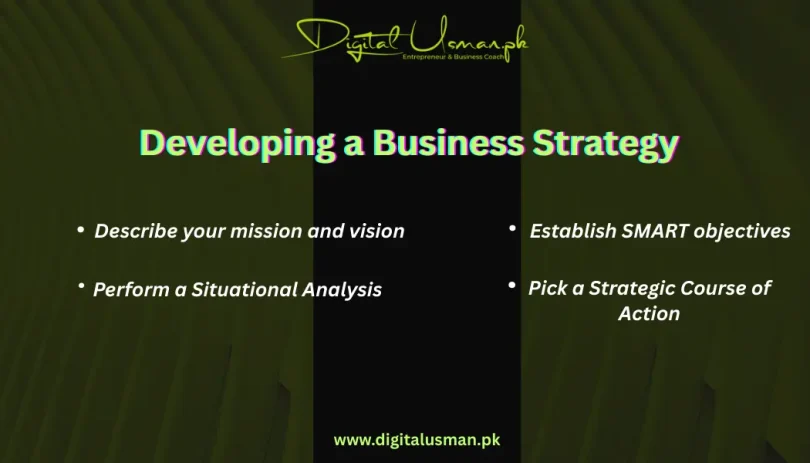
Step 1: Define Your Vision and Mission
The first step in creating a business strategy is defining your vision and mission. A vision describes what your business wants to achieve in the future, while a mission explains the purpose of the organization and how it serves customers.
Having a clear vision and mission helps guide decision-making and ensures that all strategic efforts align with the organization’s long-term objectives. These statements provide direction and inspire employees to work toward common goals.
Step 2: Set Clear Business Goals
Once your vision and mission are established, identify specific business goals. Goals should be measurable, realistic, and aligned with your overall strategy.
Examples include increasing revenue, expanding into new markets, improving customer satisfaction, launching new products, or reducing operational costs. Clearly defined goals provide a basis for evaluating performance and tracking progress.
Step 3: Analyze the Market
Understanding the market is essential for developing an effective strategy. Conduct research to identify industry trends, customer needs, and emerging opportunities.
Market analysis helps businesses understand demand patterns, customer preferences, and competitive dynamics. This information allows organizations to make informed decisions and position themselves effectively within their industry.
Step 4: Identify Your Target Audience
Every successful business strategy focuses on serving a specific audience. Identify who your ideal customers are, what they need, and how your products or services can solve their problems.
Creating customer profiles helps businesses develop targeted marketing campaigns, improve customer experiences, and build stronger relationships with their audience.
Step 5: Conduct a SWOT Analysis
SWOT analysis is a powerful strategic planning tool that examines:
- Strengths
- Weaknesses
- Opportunities
- Threats
Strengths and weaknesses are internal factors, while opportunities and threats are external factors. This analysis provides valuable insights that help businesses leverage advantages and address potential challenges.
Step 6: Study Your Competitors
Competitor analysis helps businesses understand the strengths and weaknesses of rival companies. Examine competitors’ products, pricing strategies, marketing efforts, customer service, and market positioning.
Learning from competitors can reveal opportunities for differentiation and innovation. It also helps businesses identify gaps in the market that they can exploit.
Step 7: Develop Your Value Proposition
A value proposition explains why customers should choose your business over competitors. It highlights the unique benefits and advantages your products or services offer.
An effective value proposition focuses on solving customer problems, delivering value, and creating a compelling reason for customers to buy from your business.
Step 8: Choose Strategic Initiatives
Strategic initiatives are specific actions designed to achieve business goals. These may include launching new products, entering new markets, investing in technology, improving customer service, or enhancing operational efficiency.
Selecting the right initiatives ensures that resources are focused on activities that contribute to long-term success.
Step 9: Create an Action Plan
An action plan outlines the steps required to implement your strategy. It should include timelines, responsibilities, budgets, and performance indicators.
Breaking large goals into smaller tasks makes implementation more manageable and increases accountability throughout the organization.
Step 10: Monitor and Adjust
Business strategy is not a one-time activity. Regularly review performance metrics and evaluate progress toward goals.
Market conditions, customer preferences, and competitive landscapes can change over time. Continuous monitoring allows businesses to adjust strategies and remain competitive in evolving environments.
Benefits of Business Strategy
- Provides clear direction and purpose
- Improves decision-making processes
- Helps achieve long-term business goals
- Creates a competitive advantage
- Enhances resource allocation
- Increases operational efficiency
- Supports sustainable growth
- Improves risk management
- Strengthens customer satisfaction
- Encourages innovation and adaptability
- Aligns organizational efforts
- Boosts profitability
- Facilitates performance measurement
- Improves employee engagement
- Helps businesses respond effectively to market changes
Disadvantages / Risks of Business Strategy
- Poor planning can lead to ineffective outcomes
- Overly rigid strategies may limit flexibility
- Market conditions can change unexpectedly
- Strategic implementation may require significant investment
- Incorrect assumptions can result in poor decisions
- Resistance to change may hinder execution
- Excessive focus on long-term goals may overlook immediate issues
- Competitor actions can disrupt strategic plans
- Resource limitations may affect implementation
- Inaccurate data can reduce strategic effectiveness
Common Mistakes to Avoid
One of the most common mistakes businesses make is failing to define clear objectives. Without measurable goals, it becomes difficult to assess progress and determine whether the strategy is working effectively.
Another mistake is ignoring market research. Decisions based on assumptions rather than data often lead to poor outcomes. Understanding customer needs and industry trends is critical for success.
Many organizations also underestimate the importance of competitor analysis. Failing to monitor competitors can result in missed opportunities and reduced competitiveness.
Another common error is creating strategies that are too complex. A successful strategy should be clear, practical, and easy to communicate throughout the organization.
Businesses often neglect implementation planning as well. Even the best strategy will fail without proper execution, accountability, and performance monitoring.
Finally, some organizations resist adapting their strategies when circumstances change. Flexibility is essential for long-term success in dynamic business environments.
FAQs
1. What is the main purpose of business strategy?
The main purpose of business strategy is to provide a clear roadmap for achieving organizational goals. It helps businesses allocate resources effectively, compete successfully, and achieve sustainable growth.
2. How often should a business strategy be reviewed?
A business strategy should be reviewed regularly, typically every quarter or annually. Frequent reviews help organizations adapt to market changes and maintain alignment with business goals.
3. Can small businesses benefit from business strategy?
Yes, small businesses can benefit significantly from strategic planning. A clear strategy helps small businesses prioritize activities, manage resources efficiently, and compete more effectively.
4. What is a competitive advantage?
A competitive advantage is a unique characteristic that allows a business to outperform competitors. This may include superior products, exceptional customer service, innovative technology, or lower costs.
5. What is SWOT analysis in business strategy?
SWOT analysis is a strategic planning framework used to evaluate strengths, weaknesses, opportunities, and threats. It helps businesses understand their position and make informed decisions.
6. Why is customer analysis important in strategy development?
Customer analysis helps businesses understand customer needs, preferences, and behaviors. This knowledge allows organizations to create products, services, and marketing campaigns that better meet customer expectations.
7. What role does innovation play in business strategy?
Innovation helps businesses stay competitive by introducing new products, improving processes, and adapting to changing market demands. It supports long-term growth and sustainability.
8. What happens if a business has no strategy?
Without a strategy, businesses often lack direction, struggle with decision-making, waste resources, and face difficulties responding to market changes. This can reduce profitability and growth potential.
Expert Tips & Bonus Points
Successful business leaders focus on creating strategies that balance long-term vision with short-term execution. Setting realistic goals and maintaining flexibility allows organizations to adapt while staying focused on their objectives.
Always use data-driven decision-making whenever possible. Reliable information improves strategic accuracy and reduces uncertainty. Invest in customer research, market analysis, and performance tracking to support informed decisions.
Encourage collaboration across departments. A strategy becomes more effective when employees understand organizational goals and contribute to implementation efforts.
Regularly evaluate key performance indicators (KPIs) to measure progress. Monitoring results helps identify strengths, weaknesses, and opportunities for improvement.
Focus on delivering exceptional customer value. Businesses that consistently solve customer problems and exceed expectations are more likely to achieve long-term success.
Never stop learning from competitors, industry trends, and market developments. Continuous improvement and adaptability are essential characteristics of successful organizations.
Conclusion
Business strategy is one of the most important elements of long-term organizational success. It provides a structured framework for setting goals, making decisions, allocating resources, and achieving sustainable growth. Whether you are starting a new business or managing an established company, a well-defined strategy helps you stay focused and competitive in an ever-changing marketplace.
By understanding your market, identifying your target audience, analyzing competitors, and developing a strong value proposition, you can create a strategy that supports meaningful business growth. Strategic planning also enables organizations to manage risks, improve efficiency, and seize opportunities as they arise.
While developing a business strategy requires time and effort, the benefits far outweigh the challenges. Businesses that plan effectively are better equipped to adapt to market changes, overcome obstacles, and achieve their objectives. Success does not happen by chance; it results from careful planning, consistent execution, and ongoing improvement.
For beginners, the key is to start with clear goals, gather reliable information, and remain flexible as circumstances evolve. By following the principles and steps outlined in this guide, you can build a strong business strategy that supports sustainable growth, increased profitability, and long-term success in today’s competitive business environment.